

Online advertising can boost your business. It reaches millions of potential customers.
But, how do you make your ads stand out? In today’s digital world, online advertising is essential for success. It can be tricky to navigate with so many platforms and strategies available. Whether you’re new to advertising or looking to improve your current efforts, understanding key tips can make a big difference.
From selecting the right platform to crafting compelling messages, these tips will help you attract the right audience. Stay tuned to learn how to optimize your online ad campaigns and see better results.
Choosing The Right Platforms
Choosing the right platforms for online advertising can be daunting. The digital landscape offers numerous options. Each platform has unique features. The goal is to reach your audience effectively. Let’s explore some key platforms.
Social Media Options
Social media platforms are powerful tools. They offer vast user bases and targeting options. Here are some popular choices:
- Facebook: With over 2.8 billion users, Facebook is a giant. It offers detailed targeting options. You can reach specific demographics, interests, and behaviors.
- Instagram: Instagram is popular among younger audiences. It focuses on visual content. Use high-quality images and videos to engage users.
- Twitter: Twitter is fast-paced and news-oriented. It’s ideal for real-time engagement and trending topics. Short, concise messages work best here.
- LinkedIn: LinkedIn is a professional network. It’s suitable for B2B advertising. You can target professionals based on industry, job title, and more.
- Pinterest: Pinterest is visual and discovery-driven. It’s great for niches like fashion, food, and DIY projects. Users often search for inspiration here.
Search Engine Choices
Search engines are essential for online advertising. They help you reach users actively searching for products or services. Consider these options:
- Google Ads: Google is the most popular search engine. Google Ads offers various ad formats. You can use search, display, video, and shopping ads. The platform provides advanced targeting and analytics.
- Bing Ads: Bing is a smaller but valuable search engine. Bing Ads can help you reach a different audience. It often has lower competition and cost-per-click rates.
Choosing the right platform depends on your goals and audience. Consider your budget, target audience, and campaign objectives. Each platform has unique strengths. Use a mix of platforms for a balanced strategy.
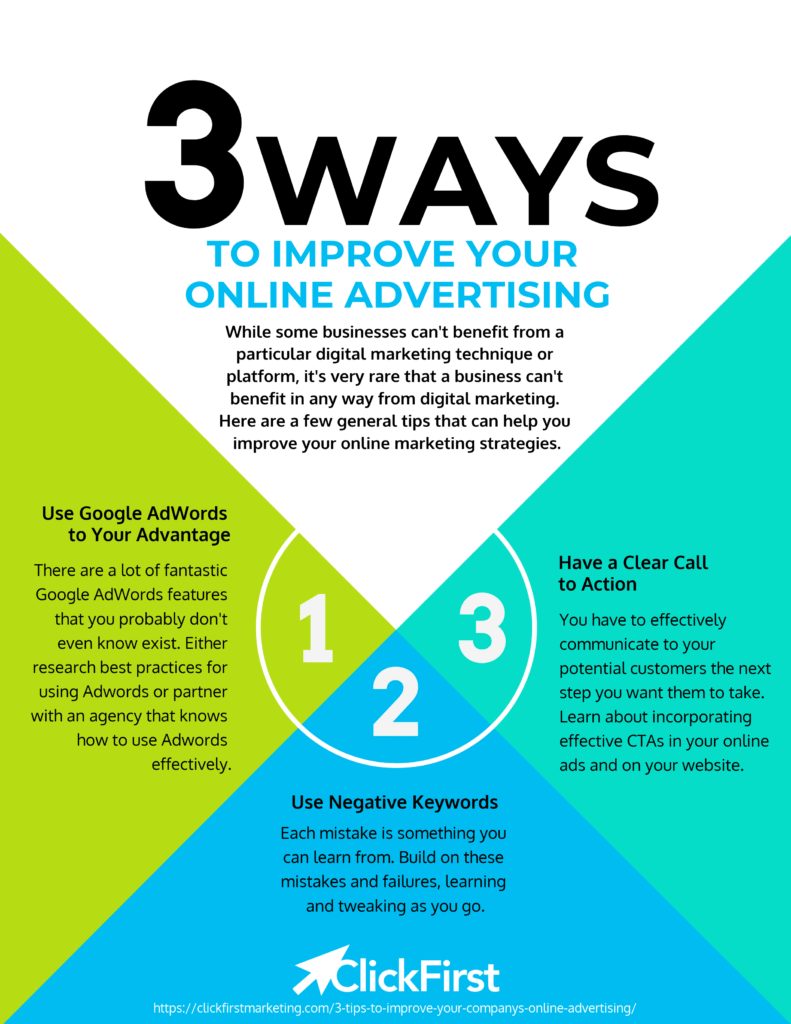
Credit: clickfirstmarketing.com
Setting Clear Objectives
Setting clear objectives is crucial for a successful online advertising campaign. Without clear goals, your campaign can lack direction and purpose. Knowing what you want to achieve helps you create focused and effective ads. This section will guide you through the process of setting clear objectives with two key components: defining goals and measuring success.
Defining Goals
Defining goals is the first step in setting clear objectives. Start by identifying what you want to achieve with your online ads. Common objectives include:
- Increasing Website Traffic: More visitors to your website.
- Boosting Sales: More purchases of your products or services.
- Generating Leads: Collecting contact information from potential customers.
- Brand Awareness: Making more people aware of your brand.
Choose one or more objectives that align with your business goals. Be specific and realistic about what you want to achieve. For example, instead of saying “increase sales,” set a goal to “increase sales by 20% in the next three months.”
Measuring Success
Measuring success is essential to understand if your online advertising is effective. Use metrics to track progress towards your objectives. Here are some common metrics:
| Objective | Metric |
|---|---|
| Increasing Website Traffic | Number of visitors, page views |
| Boosting Sales | Sales revenue, conversion rate |
| Generating Leads | Number of leads, cost per lead |
| Brand Awareness | Impressions, reach, brand mentions |
Track these metrics regularly to assess your campaign’s performance. Use tools like Google Analytics or Facebook Insights for detailed data. Adjust your strategy based on what you learn. This helps you improve your ads and achieve your goals more effectively.
Targeting Your Audience
Effective online advertising requires knowing your audience. Targeting your audience helps you deliver the right message to the right people. This increases engagement and drives conversions.
Demographic Targeting
Demographic targeting helps you reach specific groups based on characteristics. These include:
- Age
- Gender
- Location
- Income
- Education Level
For example, if you sell luxury watches, target high-income individuals. If your product is for teenagers, target the 13-19 age group. Use data from social media platforms and search engines to refine your demographic targeting.
Behavioral Targeting
Behavioral targeting focuses on users’ actions and interests online. This includes:
- Browsing History
- Search Queries
- Purchase History
- Social Media Activity
- Visited Websites
If a user frequently visits travel websites, show them ads for hotels and flights. Use cookies and tracking pixels to gather this data. Behavioral targeting helps create personalized ads, increasing the chance of conversion.
| Targeting Type | Focus | Example |
|---|---|---|
| Demographic Targeting | Age, Gender, Location, Income | Targeting high-income individuals for luxury watches |
| Behavioral Targeting | Browsing History, Search Queries | Showing ads for hotels to users visiting travel sites |
Creating Compelling Ads
Creating ads that grab attention and drive action is crucial. To succeed, focus on making your ads visually appealing and engaging. This involves selecting the right visuals and crafting compelling copy. Below are some tips to help you create ads that stand out.
Eye-catching Visuals
Visuals are the first thing people notice in an ad. They can make or break your campaign. Here are some tips for choosing the right visuals:
- High-Quality Images: Use clear and high-resolution images. Blurry or pixelated images turn people away.
- Relevant Graphics: Ensure the visuals relate to your product or service. Irrelevant images confuse your audience.
- Consistent Branding: Use colors and fonts that match your brand. This helps in brand recognition.
- Simple Design: Avoid clutter. Simple designs with a clear focal point work best.
Engaging Copy
The text in your ad needs to be short but impactful. It should catch attention and explain your offer clearly. Here are some tips for writing engaging copy:
- Strong Headlines: Use a headline that grabs attention. It should be direct and to the point.
- Clear Message: Make sure your message is clear. Avoid jargon or complex words.
- Call to Action: Include a call to action. Tell people what you want them to do next.
- Benefits Over Features: Focus on benefits rather than features. Explain how your product or service helps the user.
By focusing on these aspects, you can create ads that not only attract attention but also drive actions. Remember, the key is to make your ad visually appealing and your message clear.
Optimizing Ad Spend
Effective online advertising requires smart management of your ad spend. By optimizing ad spend, businesses can ensure their advertising budget is used efficiently. This results in higher returns on investment (ROI) and better overall campaign performance. Here are some essential tips to help you optimize your ad spend.
Budget Allocation
Allocating your budget wisely is crucial. Start by setting a realistic budget based on your financial capacity. Then, distribute it across various channels where your audience is most active.
Consider using the 70-20-10 rule:
- 70% on proven channels
- 20% on new channels or strategies
- 10% on experimental approaches
This strategy ensures a balanced approach. It allows stability while also exploring new opportunities.
Bidding Strategies
Choosing the right bidding strategy can significantly impact your campaign’s success. There are several bidding strategies to consider:
| Bidding Strategy | Description |
|---|---|
| Manual CPC | Allows control over cost-per-click bids. |
| Target CPA | Focuses on achieving a desired cost-per-acquisition. |
| Target ROAS | Aims to reach a specific return on ad spend. |
| Maximize Clicks | Attempts to get the most clicks within your budget. |
| Enhanced CPC | Adjusts manual bids for more conversions. |
Each strategy has its own benefits. Choose one that aligns with your campaign goals.

Credit: www.tegna.com
Utilizing Analytics Tools
Online advertising can be complex. To succeed, you need to measure your efforts. Utilizing analytics tools is essential. These tools help you understand your campaign’s performance. They also provide insights into your audience’s behavior. This helps you refine your strategies. Let’s explore how to make the most of analytics tools.
Tracking Performance
To track your advertising performance, use analytics tools. These tools provide data on clicks, impressions, and conversions. It’s crucial to monitor these metrics regularly. Here are some key metrics to track:
- Click-Through Rate (CTR): Measures how many people clicked your ad.
- Conversion Rate: Shows how many clicks led to a desired action.
- Cost Per Click (CPC): Indicates how much you’re paying for each click.
Regular tracking helps identify trends. It also highlights areas that need improvement. Use this data to make informed decisions.
Adjusting Campaigns
Once you have tracked your performance, it’s time to adjust your campaigns. Make changes based on the data you have collected. Here are some steps to follow:
- Identify Weak Points: Look for ads with low CTR or high CPC.
- Test Variations: Create different versions of your ads. Change headlines, images, or calls to action.
- Analyze Results: Compare the performance of each version.
- Optimize: Keep the best-performing ads and discard the rest.
Adjusting your campaigns ensures better results over time. Use analytics tools to guide your decisions. This approach maximizes your advertising budget.
Leveraging Retargeting
Online advertising is more effective with retargeting. This strategy helps you reach users who have shown interest in your products. Retargeting can boost conversion rates and increase sales. Learn how to leverage retargeting with these tips.
Identifying Potential Customers
First, you need to identify potential customers. These are users who have visited your website or interacted with your ads. Use tools like Google Analytics to track user behavior. Identify pages with high traffic and engagement. Look for patterns in user activity. This helps in targeting the right audience.
Here are some key indicators to identify potential customers:
- Visited product pages
- Added items to the cart but did not purchase
- Signed up for newsletters
- Spent significant time on your site
Retargeting Methods
There are various retargeting methods to consider. Each has its own benefits and use cases. Here are some common methods:
| Method | Description |
|---|---|
| Pixel-Based Retargeting | Uses a small piece of code on your site to track visitors. Shows ads to these users as they browse the web. |
| List-Based Retargeting | Uses a list of customer emails. Shows ads to these users on social media or other platforms. |
| Search Retargeting | Targets users based on their search queries. Shows ads related to their search terms. |
| Social Media Retargeting | Targets users on social media platforms. Shows ads based on their social media activity. |
Choose the method that best fits your campaign goals. For instance, pixel-based retargeting works well for general site visitors. List-based retargeting is great for targeting known customers. Tailor your approach to maximize effectiveness.

Credit: propellerads.com
Exploring New Trends
Online advertising continues to evolve with new trends. Keeping up with these changes can give your business a competitive edge. This section will explore emerging technologies and innovative approaches in online advertising. Stay ahead by understanding these trends.
Emerging Technologies
Emerging technologies are reshaping the online advertising landscape. Here are some key trends to watch:
- Artificial Intelligence (AI): AI can analyze user behavior and optimize ad placements.
- Programmatic Advertising: This allows for automated buying and selling of ads in real-time.
- Augmented Reality (AR): AR ads create interactive experiences, engaging users in new ways.
- Voice Search: With more voice-activated devices, optimizing for voice search can increase ad reach.
These technologies can enhance your advertising strategy. They offer new ways to connect with your audience.
Innovative Approaches
Innovation in advertising is not just about technology. Creative approaches also play a crucial role. Consider these strategies:
- Personalized Ads: Tailoring ads to individual preferences can increase engagement.
- Storytelling: Ads that tell a story can capture attention and create a connection.
- Interactive Content: Interactive ads, like quizzes or polls, can boost user interaction.
- Influencer Marketing: Partnering with influencers can expand your reach and credibility.
These innovative approaches can make your ads more effective. They can help you stand out in a crowded market.
| Technology | Benefit |
|---|---|
| AI | Optimizes ad placements |
| Programmatic Advertising | Real-time ad buying and selling |
| AR | Creates interactive experiences |
| Voice Search | Increases ad reach |
Stay updated on these trends. They can greatly impact your advertising success. Use these insights to refine your strategies and achieve better results.
Frequently Asked Questions
What Are The Best Online Advertising Platforms?
The best online advertising platforms include Google Ads, Facebook Ads, and Instagram Ads. They offer extensive targeting options. LinkedIn Ads are ideal for B2B marketing. TikTok Ads target younger audiences effectively. Each platform has unique benefits.
How Can I Improve My Ad Targeting?
Improve ad targeting by using detailed audience segmentation. Analyze demographics, interests, and behaviors. Utilize retargeting strategies for past visitors. Regularly update and refine your targeting criteria. Test different audience segments for best results.
What Is The Importance Of A/b Testing In Ads?
A/B testing helps identify the most effective ad variations. It improves ad performance by comparing different elements. By testing headlines, images, and calls-to-action, you can optimize your campaign. Regular A/B testing boosts conversion rates and lowers costs.
How Do I Measure Ad Campaign Success?
Measure ad campaign success by tracking key metrics. These include click-through rate (CTR), conversion rate, and return on ad spend (ROAS). Use analytics tools to monitor performance. Regularly review and adjust your strategy based on data insights.
Conclusion
Wrap up your online advertising with these easy tips. Stay focused on your audience. Track your results regularly. Adjust your strategies based on data. Keep your ads clear and engaging. Simple changes can lead to better performance. Remember, patience and consistency are key.
Happy advertising!